Fluid Physical Properties
Understanding Fluid Physical Properties is critical for accurate hydraulic modeling and thermal analysis. The ThermoFlowPro database provides essential data on density, dynamic viscosity, kinematic viscosity, and thermal conductivity for various fluids, including water, refrigerants, and oils. Whether you are calculating Reynolds numbers or heat transfer coefficients, our precise data ensures your engineering calculations align with real-world fluid behavior.
Version : 1.0.0
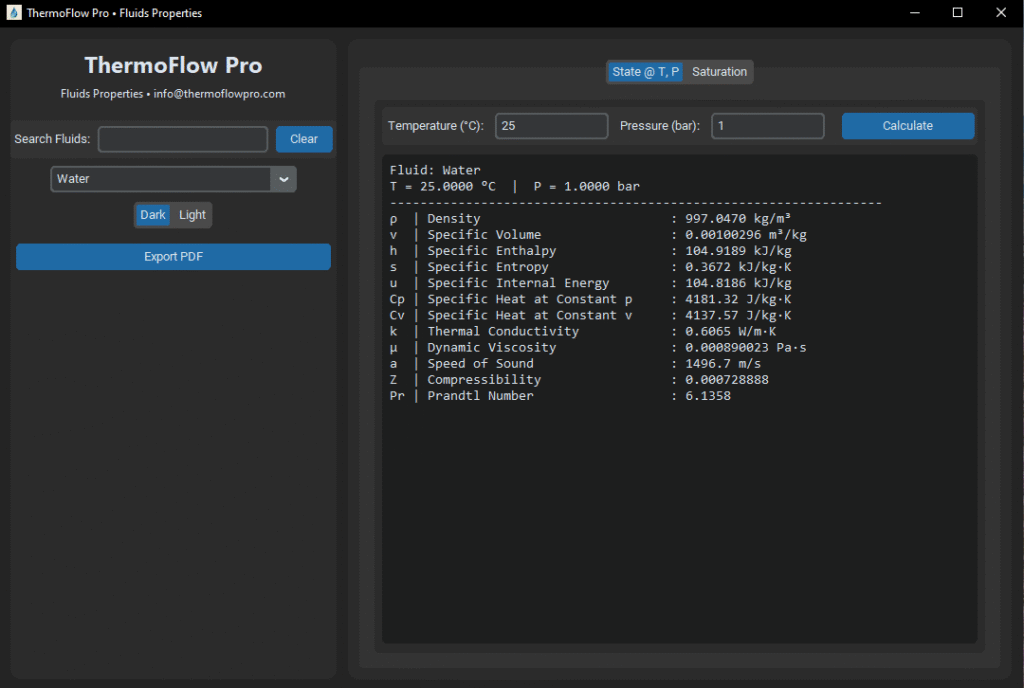
Application Screen Shoot
Key Fluid Properties Explained
Density
The mass per unit volume of a fluid. It varies significantly with temperature, especially for gases, affecting pressure drop and flow rate calculations.
Dynamic vs. Kinematic Viscosity
-
Dynamic Viscosity : A measure of a fluid’s internal resistance to flow.
-
Kinematic Viscosity : The ratio of dynamic viscosity to density, essential for determining the flow regime (Laminar vs. Turbulent).
Specific Heat
Crucial for HVAC engineers designing chilled water or hot water systems to determine the energy carrying capacity of the fluid.
How to Use the Calculator
Select Fluid Type: Choose from Water, Ethylene Glycol, Air, or Steam.
Enter Temperature: Input the working temperature of your system.
Get Results: Instantly retrieve all physical properties required for your MEP calculations.
FAQ
- Q: Why does water density decrease as temperature rises? A: As temperature increases, molecules move faster and take up more space, leading to a decrease in mass per unit volume.
- Q: What is the importance of Viscosity in pipe sizing? A: Viscosity directly affects the Reynolds Number; higher viscosity leads to higher friction loss and requires larger pump heads.
- Q: What properties does the application cover? Density, Specification Volume, Specific Enthalpy, Specific Entropy, Specific Heat, Thermal Conductivity, Dynamic Viscosity, ….. etc
- What can I do with this calculator? You can get properties of fluid (Water, air, gases, Liquids,….) at specific temperature and pressure. You can get saturation liquid and saturation vapour at specific conditions.