📐 Pipe Sizing Calculator

Optimize your piping network with the ThermoFlowPro Pipe Sizing Calculator. Choosing the correct pipe diameter is essential to balance material costs with system performance. Our tool helps MEP engineers determine the ideal pipe size based on flow rate (GPM/LPS), allowable velocity, and head loss gradients. Ensure your design prevents noise, erosion, and excessive pressure drops by using our industry-standard hydraulic calculations.

Version : 1.0.1

Pipe Sizing Calculator

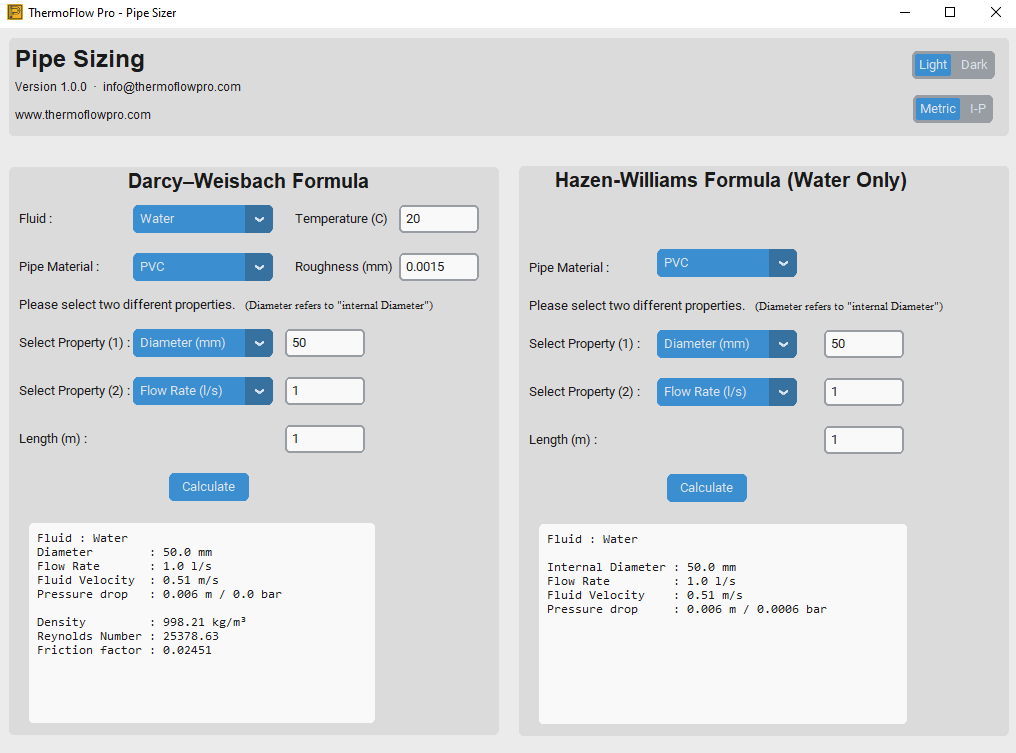
Application Screen Shoot

Design Criteria & Methods

Sizing by Velocity Limits

To prevent pipe erosion and water hammer, pipes must be sized within specific velocity ranges. Our calculator flags instances where velocity exceeds recommended limits (e.g., 5-8 ft/s for pumped water).

Sizing by Pressure Drop (Friction Loss)

Commonly used in chilled water and heating systems, where you aim for a specific friction rate (e.g., 2.4 to 4.0 ft of head per 100 ft of pipe) to ensure pump efficiency.

Supported Pipe Materials

The calculator accounts for the internal diameter (ID) and roughness of various materials:

  • Plastic Pipes: PVC (Sch 40/80), CPVC, and HDPE.

  • Metallic Pipes: Copper (Type K, L, M), Carbon Steel, and Ductile Iron.

  • Stainless Steel: For industrial and high-purity applications.

How to Size Your Pipes

  • Enter Flow Rate: Input your design flow in GPM, LPS, or $m^3/h$.

  • Select Material: Choose the pipe type to pull the correct internal dimensions.

  • Set Constraints: Input your maximum allowable velocity or friction loss.

  • View Results: The tool suggests the Nominal Pipe Size (NPS) that fits your criteria.

FAQ

  • Q: What happens if the pipe is undersized? A: Undersized pipes lead to high velocities, which cause loud noise, vibration, and rapid erosion of the pipe walls.

    Q: Why not use oversized pipes for everything? A: While oversized pipes reduce friction, they significantly increase project material costs and can lead to sediment buildup due to low velocities.

Reference

Scroll to Top